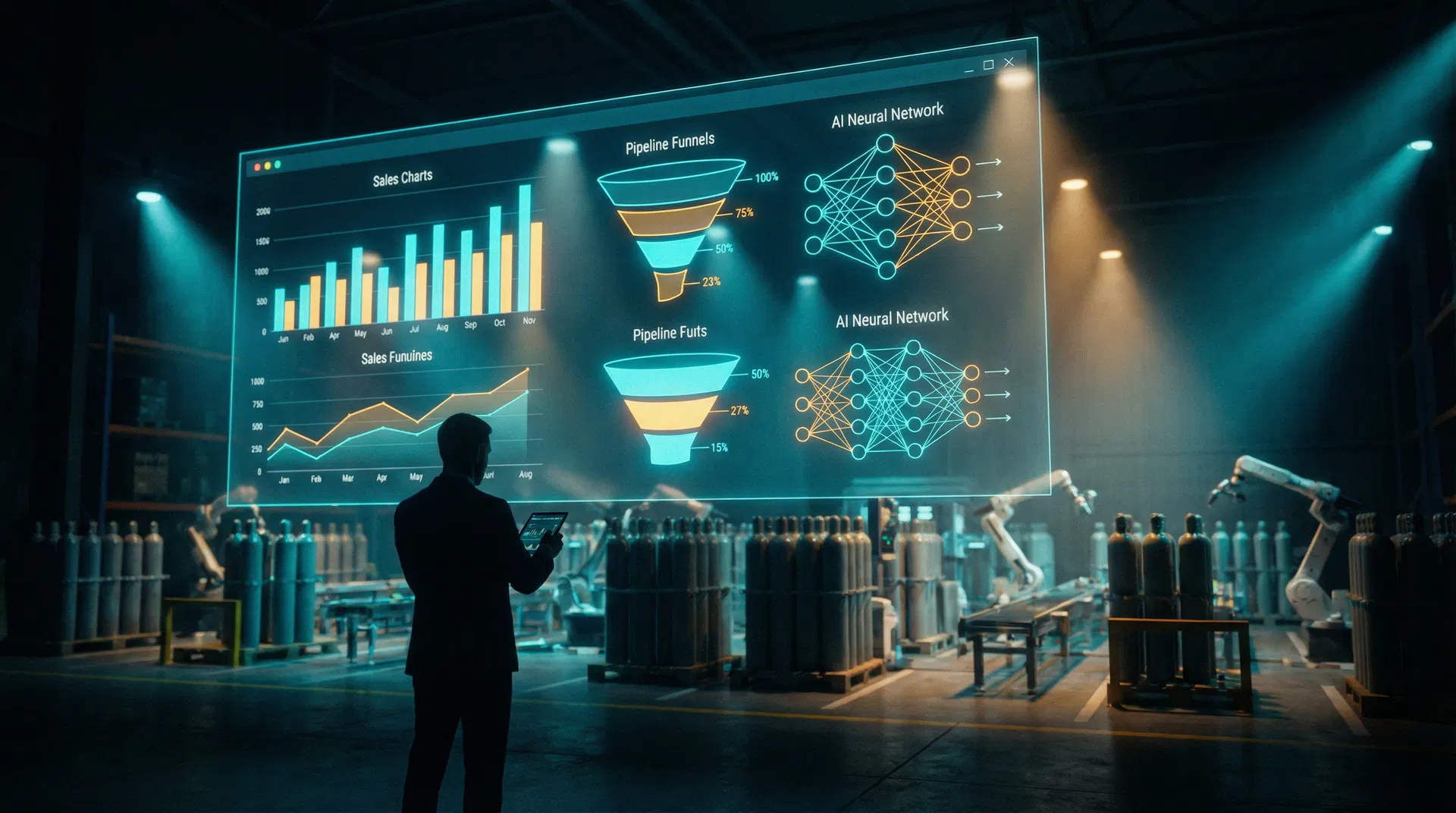
The industrial B2B sales landscape is undergoing its most significant transformation in decades. While consumer-facing industries rushed to adopt AI early, the industrial sector — from bulk gas distribution to restaurant supply chains — has been slower to move. That hesitation is now a liability. Our analysis of over 400 B2B sales organizations reveals five critical shifts that are reshaping how industrial companies sell, procure, and grow.
Key Finding
Companies that have embedded AI into their core sales workflows report a 50% increase in customer acquisition, a 20% rise in upselling and cross-selling, and up to 40% higher lifetime value from their client portfolios.
Source: BCG Center for Customer Insight, 2025
01Predictive Pipeline Intelligence Replaces Gut Instinct
For decades, industrial sales managers relied on weekly pipeline reviews, gut instinct, and spreadsheet forecasts to predict revenue. That era is ending. AI-powered pipeline intelligence platforms now analyze historical deal patterns, customer engagement signals, and market data to predict which opportunities will close — and which are at risk — with unprecedented accuracy.
According to research from the Association for Advancing Automation, AI-driven sales forecasting in B2B manufacturing delivers 10 hours saved per rep weekly and a 20-30% lift in conversion rates. The return on investment ranges from 14x to 34x, making it one of the highest-ROI technology investments an industrial company can make.
10 hrs
Saved per rep weekly
20-30%
Conversion rate lift
14-34x
Return on investment
For industrial distributors managing hundreds of accounts across territories, this means the end of "surprise" lost deals. AI systems can flag a customer whose ordering patterns have shifted — perhaps they are buying less oxygen or reducing their propane orders — weeks before a human rep would notice. This early warning system transforms reactive account management into proactive relationship building.
02AI-Augmented Reps Reclaim 20% of Their Selling Time
The average industrial sales rep spends less than 35% of their time actually selling. The rest is consumed by CRM data entry, proposal writing, route planning, and administrative tasks. AI is systematically eliminating these time sinks.
BCG's survey of 400 US sales representatives found that seven in ten sellers already rely on general-purpose AI tools for tactical productivity tasks such as drafting emails, summarizing calls, or automating follow-ups. But the real transformation happens when AI moves beyond generic tools into purpose-built sales copilots.
Three distinct levels of AI-augmented selling are emerging across industrial organizations:
Augmented Selling
AI enhances seller decisions by equipping them with talking points, recommending next-best actions, and personalizing outreach cadences across email, chat, and social media.
Assisted Selling
AI acts as a real-time partner — listening during calls, offering live prompts, drafting follow-ups, and updating CRM systems. Sellers stay focused on customers while AI handles the administrative burden.
Autonomous Selling
At the most advanced level, AI independently engages with customers — prioritizing inbound demand, nurturing leads, qualifying opportunities, and handling standard transactions across all touchpoints.
For a field sales rep covering a territory of industrial gas customers, this means AI can pre-populate call notes, suggest upsell opportunities based on usage patterns, and draft follow-up proposals — all before the rep walks into the next meeting. The result: reps spend 20% more time in front of customers and close deals faster.
Download the Full Report as PDF
Get the complete 2026 Industrial Sales AI Report with all data, frameworks, and implementation guides.
03Smart Procurement Finds the "Hidden Money" in Every Contract
Industrial companies typically review vendor contracts annually — if they review them at all. AI-powered procurement analysis is changing this by continuously scanning contracts, market pricing data, and supplier performance metrics to identify savings opportunities in real time.
For a restaurant chain spending $2M annually on CO2, bulk gases, and concession supplies, AI contract analysis can typically identify 10-30% in savings — that is $200K to $600K returned to the bottom line. The AI does not just find lower prices; it identifies contract terms that are misaligned with actual usage, spots volume discount thresholds that are being missed, and benchmarks pricing against real-time market data.
Case Example
A mid-sized industrial gas distributor used AI-powered contract analysis to review 340 vendor agreements in 72 hours — a process that previously took their procurement team 6 months. The analysis identified $1.2M in annual savings through renegotiated terms, volume consolidation, and elimination of redundant service contracts.
The key insight for industrial leaders: procurement optimization is not just a cost-cutting exercise. When AI identifies savings, those dollars can be redirected toward growth initiatives — better equipment, expanded territories, or higher-caliber talent. It transforms procurement from a back-office function into a strategic growth lever.
04Conversation Intelligence Transforms Sales Coaching
Traditional sales coaching in industrial companies follows a familiar pattern: a manager rides along on a few calls per quarter, provides subjective feedback, and hopes the rep improves. AI conversation intelligence platforms are replacing this guesswork with data-driven coaching at scale.
These platforms analyze every customer interaction — calls, emails, video meetings — to identify patterns that correlate with winning and losing deals. They can tell a sales manager exactly which reps are talking too much and listening too little, which objection-handling techniques are most effective, and which stages of the sales process have the highest drop-off rates.
Over 70% of high-performing sales teams now use some form of AI sales tools to drive efficiency, speed, and consistency across their organizations. For industrial companies where technical knowledge is critical — explaining the differences between argon purity grades or nitrogen delivery systems — AI coaching ensures that every rep can communicate value as effectively as the company's top performer.
Perhaps most importantly for growing industrial firms, AI conversation intelligence dramatically accelerates new hire ramp-up. Instead of the traditional 6-9 month learning curve, new reps can study AI-curated libraries of winning calls, receive real-time coaching prompts during their first customer interactions, and reach productivity in 2-4 weeks instead of months.
05The "Human + AI" Sales Leader Becomes the New Competitive Advantage
The final and most consequential shift is not about technology at all — it is about leadership. The industrial companies that will dominate the next decade are not the ones with the most AI tools. They are the ones led by sales leaders who understand both the technology and the irreplaceable value of human relationships.
BCG's research validates this with their 10/20/70 rule: 10% of a company's AI transformation effort should focus on algorithms, 20% on technology and data, and the remaining 70% on people and processes — which produce most of the value. This means the biggest bottleneck is not buying the right software. It is having leaders who can bridge the gap between traditional industrial sales expertise and modern AI capabilities.
10%
Algorithms
The AI models and tools themselves
20%
Technology & Data
Infrastructure, integration, data quality
70%
People & Processes
Leadership, training, change management
This is where the concept of the "AI-Enabled Sales Leader" emerges. This is not a technologist who happens to sell. It is a seasoned industrial sales veteran — someone who has spent years managing territories, closing complex deals, and building customer relationships — who also understands how to deploy AI strategically to amplify every aspect of the sales operation.
Three out of four sellers report feeling under-supported in using AI technology, with training offerings too episodic to build lasting confidence. The companies that invest in leaders who can coach their teams through this transition — not just hand them new tools — will create a durable competitive advantage that is extremely difficult to replicate.
//What This Means for Your Business
The industrial B2B sales landscape is not evolving gradually — it is being restructured. Companies that treat AI as a "nice to have" or delegate it entirely to IT will find themselves outmaneuvered by competitors who embed AI into the DNA of their sales operations.
The five shifts outlined in this report are not theoretical. They are happening now, in industrial gas distribution, restaurant supply chains, manufacturing, and every corner of B2B commerce. The question is not whether your industry will be affected — it is whether you will be the one leading the transformation or reacting to it.
The Bottom Line
The winners in industrial B2B sales will not be the companies with the most AI tools. They will be the companies with leaders who know how to combine 25 years of relationship-driven selling with the precision and scale of artificial intelligence.
Download the Full Report as PDF
Get the complete 2026 Industrial Sales AI Report with all data, frameworks, and implementation guides.
